
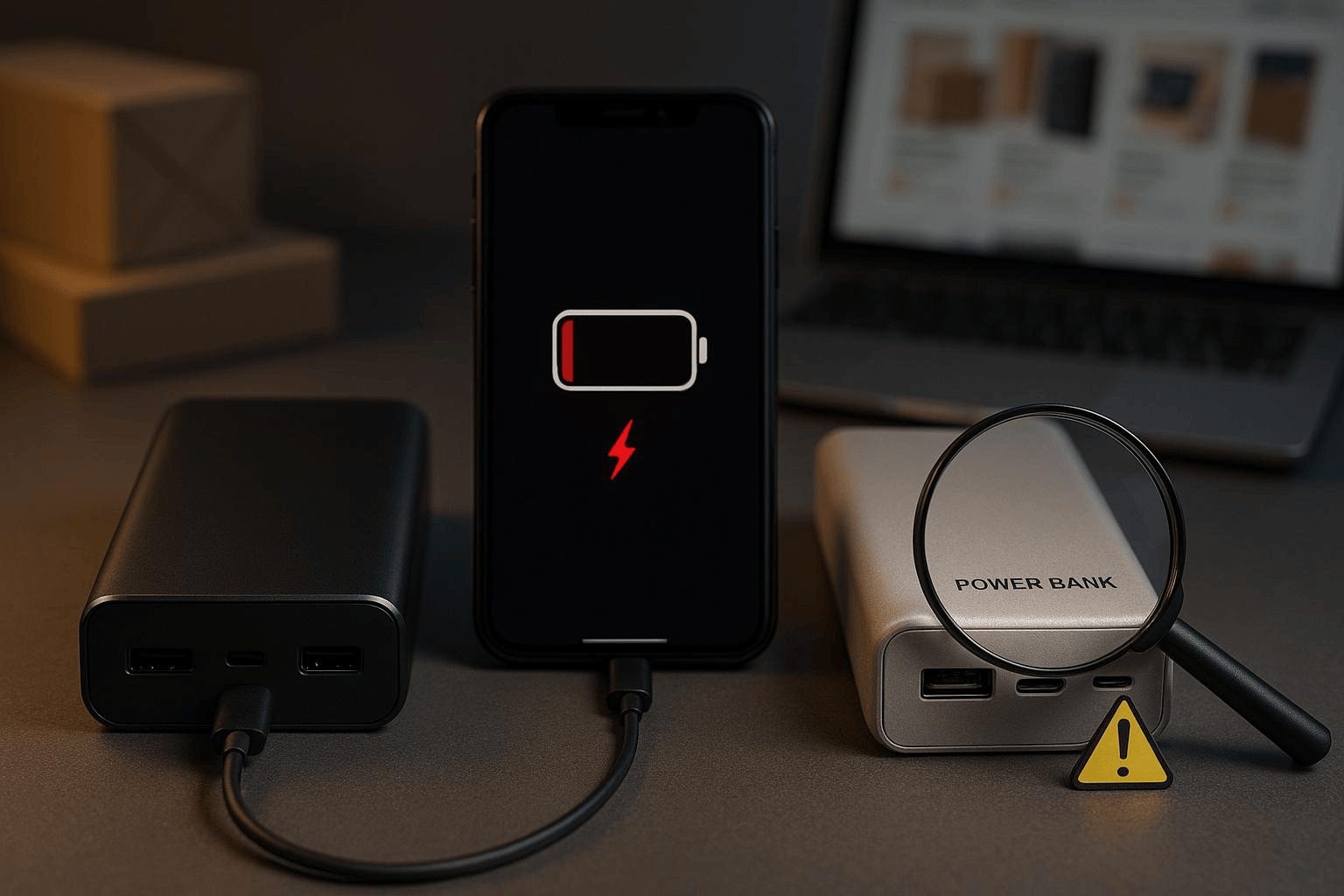
How to Choose a Power Bank That Lasts: Avoid Fake Capacity and Buy Smart in 2026 Leave a comment
A power bank is one of the most useful accessories you can own, especially if you rely on your smartphone, tablet, or laptop throughout the day. But with hundreds of options available online and in local stores, choosing the right one isn’t always easy.
Many cheap power banks advertise huge capacities like 50,000mAh, 80,000mAh, or even 100,000mAh, yet fail to deliver anywhere close to those numbers. In many cases, these products contain low-quality battery cells or display fake capacity ratings designed to attract buyers.
This guide explains how to choose a power bank that lasts, how to spot fake capacity claims, and what features to look for before spending your money.
Why Fake Capacity Is a Problem
The battery capacity printed on a power bank should indicate how much energy it can store. Unfortunately, counterfeit or low-quality products often exaggerate this figure.
For example, a power bank advertised as 50,000mAh may actually contain only 8,000–12,000mAh worth of usable battery cells.
The result?
- Your phone charges fewer times than expected.
- Charging speed is inconsistent.
- Battery performance deteriorates quickly.
- The power bank may overheat or fail prematurely.
A fake capacity doesn’t just waste your money—it can also put your devices at risk.
1. Be Skeptical of Unrealistic Capacity Claims
One of the biggest warning signs is an unusually high capacity at a very low price.
Be cautious if you see:
- 50,000mAh for an unusually cheap price
- 80,000mAh in a compact pocket-sized design
- 100,000mAh models without a recognized brand
Large-capacity batteries require more battery cells, making them physically larger, heavier, and more expensive.
If something seems too good to be true, it probably is.
2. Buy from Reputable Brands
Trusted manufacturers invest in quality battery cells, safety features, and product testing.
Some of the most reliable brands include:
- Anker
- UGREEN
- Baseus
- Xiaomi
- Romoss
- Oraimo
- Belkin
- INIU
Buying genuine products from reputable sellers significantly reduces the risk of receiving counterfeit accessories.
3. Check the Power Output
Capacity isn’t everything. A power bank also needs enough output to charge your devices efficiently.
Choose based on your needs:
- 18W–30W: Smartphones and earbuds
- 45W–65W: Tablets and many ultrabooks
- 100W or more: High-performance USB-C laptops
If you own a USB-C laptop, make sure the power bank supports USB Power Delivery (PD).
4. Look for Quality Battery Cells
High-quality power banks typically use premium lithium-ion or lithium-polymer cells from reputable manufacturers.
Quality battery cells provide:
- Longer lifespan
- Better efficiency
- Improved charging stability
- Lower heat generation
- More charging cycles
Cheaper battery cells often lose capacity much faster over time.
5. Check the Weight
Battery capacity and weight usually go hand in hand.
If a “50,000mAh” power bank feels unusually light, that’s a red flag.
A genuine high-capacity power bank is generally heavier because it contains more battery cells.
6. Choose USB-C Power Delivery (PD)
USB-C Power Delivery has become the standard for modern charging.
Benefits include:
- Faster charging
- Better efficiency
- Laptop compatibility
- Future-proof connectivity
Avoid buying power banks that rely solely on outdated charging standards if you use newer devices.
7. Look for Built-In Safety Features
A quality power bank should include multiple layers of protection, such as:
- Overcharge protection
- Overcurrent protection
- Short-circuit protection
- Temperature monitoring
- Over-voltage protection
These features help protect both the power bank and your devices.
8. Read Reviews Before Buying
Before making a purchase, check trusted reviews and verified customer feedback.
Look for comments about:
- Real charging capacity
- Charging speed
- Heat generation
- Long-term reliability
- Build quality
Consistent positive feedback is often a good indicator of a reliable product.
9. Buy from Trusted Retailers
Counterfeit accessories are common on unofficial marketplaces.
Whenever possible, buy from:
- Authorized brand stores
- Reputable electronics retailers
- Trusted online marketplaces with verified sellers
Avoid sellers who cannot confirm a product’s authenticity.
10. Match the Capacity to Your Needs
Not everyone needs the biggest power bank.
10,000mAh
- Daily commuting
- Light smartphone use
- Easy to carry
20,000mAh
- Travel
- Students
- Business professionals
- Multiple phone charges
25,000–30,000mAh
- Laptop charging
- Remote work
- Long trips
- Content creation
Choosing the right capacity helps you balance portability and performance.
Quick Checklist Before You Buy
✔ Buy from a reputable brand
✔ Verify the stated capacity
✔ Choose USB-C Power Delivery (PD)
✔ Check the power output
✔ Look for built-in safety protections
✔ Read verified customer reviews
✔ Avoid prices that seem too good to be true
✔ Purchase from trusted retailers
Final Thoughts
A reliable power bank is an investment in convenience, productivity, and device safety. While fake-capacity models may look attractive because of their low prices and exaggerated specifications, they rarely deliver the performance they promise.
Instead of focusing only on the biggest number printed on the box, pay attention to the brand, build quality, charging technology, safety features, and seller reputation. A genuine 20,000mAh power bank from a trusted manufacturer will often outperform a counterfeit model claiming 50,000mAh.
By making an informed choice, you’ll enjoy faster charging, better battery life, and a power bank that serves you reliably for years.
Have you ever bought a power bank that didn’t live up to its advertised capacity? Share your experience in the comments and help others make smarter buying decisions.
Follow www.sunnydaygadgets.com for honest gadget reviews, cybersecurity insights, buying guides, and practical technology tips to help you stay informed and protected.
