
Stop Wasting Money on Fake Chargers: How to Spot Counterfeit Phone Chargers Before They Damage Your Device Leave a comment
A cheap phone charger can look like a great deal—until it overheats, charges painfully slowly, damages your battery, or becomes a genuine safety hazard.
With thousands of chargers and charging cables available in Nigerian markets and online stores, it can be difficult to distinguish a genuine, certified charger from a counterfeit product designed to look like one.
For smartphone users, buying the cheapest charger isn’t always the smartest way to save money. In many cases, a quality charger can actually save you money in the long run by protecting your phone, battery, and even your home.
Why Fake Chargers Are So Dangerous
Counterfeit chargers aren’t simply cheaper versions of genuine products. Many are manufactured without meeting the electrical and safety standards expected of reputable charging accessories.
A poorly made charger may have inadequate insulation, low-quality components, poor voltage regulation, or insufficient protection against electrical faults.
This can lead to:
- 🔥 Excessive heat
- ⚡ Electrical shocks
- 🔋 Faster battery degradation
- 📱 Charging problems
- 💥 Short circuits
- 🔌 Damage to the charging port
- 🏠 Potential fire hazards
A charger that costs ₦3,000 instead of ₦15,000 may seem like a bargain, but replacing a damaged smartphone could cost hundreds of thousands of naira.
1. Don’t Judge a Charger by Its Price Alone
One of the biggest mistakes shoppers make is assuming that the cheapest charger is automatically the best deal.
While genuine accessories sometimes go on sale, an unusually low price should make you cautious.
If an accessory that normally sells for ₦15,000 is being offered for ₦2,000 without a convincing explanation, take a closer look.
Ask yourself:
Why is this product so much cheaper?
It could be a legitimate clearance sale—but it could also be counterfeit.
2. Check the Packaging Carefully
Packaging is one of the easiest places to spot suspicious products.
Look for:
- Misspelled words
- Poor-quality printing
- Blurry logos
- Incorrect product information
- Missing manufacturer details
- Strange fonts or inconsistent branding
- Missing safety information
- Damaged or poorly sealed packaging
Counterfeit manufacturers often copy the appearance of popular brands but don’t always reproduce the packaging accurately.
However, good packaging doesn’t automatically prove that a charger is genuine. Some counterfeit products have surprisingly convincing packaging.
3. Examine the Charger Itself
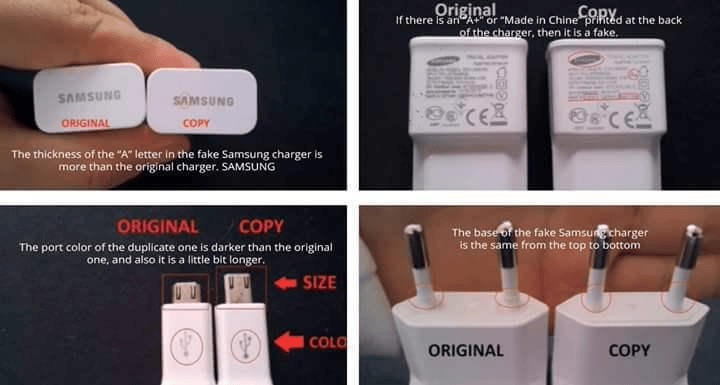
Take a close look at the physical charger.
A quality charger should generally have clean construction and clearly printed specifications.
Be cautious if you notice:
- Extremely lightweight construction
- Loose or poorly fitted components
- Rough plastic edges
- Crooked printing
- Missing specifications
- Loose USB ports
- Poor-quality pins
- Unusual smells
- Excessive heat during charging
A lightweight charger isn’t automatically fake, but an unusually light adapter can sometimes indicate that cheaper internal components have been used.
4. Check the Power Specifications
Look at the information printed on the charger.
You should normally find specifications such as:
Input: 100–240V ~ 50/60Hz
Output: 5V, 9V, 12V, etc.
The exact specifications depend on the charger.
Be suspicious of products with vague, incomplete, or obviously unrealistic specifications.
For example, a tiny inexpensive charger claiming extremely high charging power without providing proper technical information deserves extra scrutiny.
5. Don’t Ignore Excessive Heat
Some warmth during charging can be normal.
However, if your charger becomes uncomfortably hot, produces a burning smell, makes unusual noises, or repeatedly disconnects and reconnects, stop using it.
Don’t assume that overheating is simply a normal characteristic of fast charging.
A faulty charger could potentially damage your device or create a safety risk.
6. Be Careful With Fake Fast-Charging Claims
Fast charging has become an important smartphone feature, but not every charger advertised as “Fast Charge,” “Super Fast,” or “100W” can actually deliver those speeds safely.
Different phones use different charging standards and protocols.
A charger should support the appropriate standard for your smartphone.
For example, depending on the device, you may encounter technologies such as:
- USB Power Delivery (USB-PD)
- Programmable Power Supply (PPS)
- Qualcomm Quick Charge
- Samsung Super Fast Charging
- Proprietary charging technologies
Don’t simply choose a charger because it has the biggest wattage number printed on the box.
Compatibility matters.
7. Your Charging Cable Matters Too
The charger isn’t the only thing you need to worry about.
A poor-quality USB cable can also cause charging problems.
Cheap cables may:
- Charge slowly
- Become hot
- Disconnect frequently
- Fail to support fast charging
- Have weak connectors
- Become damaged quickly
If you’re purchasing a high-power charger, make sure the cable is also capable of handling the required power and data specifications.
8. Buy From Trusted Sellers
Perhaps the easiest way to reduce your chances of purchasing a counterfeit charger is to buy from reputable retailers and authorized sellers.
Avoid purchasing expensive charging accessories from sellers who:
- Cannot provide product information
- Have no return policy
- Sell everything at suspiciously low prices
- Refuse to provide receipts
- Cannot explain the charger’s specifications
- Sell products with obvious packaging inconsistencies
When buying online, check the seller’s ratings, reviews, return policy, and business information.
9. Don’t Buy a Charger Just Because It Has a Famous Logo
A common mistake is assuming that a charger is genuine simply because it has an Apple, Samsung, Anker, Xiaomi, or other major brand logo printed on it.
Counterfeit manufacturers can reproduce logos and packaging.
Instead, consider the entire product:
Seller + packaging + specifications + build quality + price + authenticity verification.
If several things don’t add up, don’t buy it.
10. Watch What Happens When You Plug It In
Your smartphone can sometimes provide clues that something isn’t right.
Pay attention if your phone:
- Charges unusually slowly
- Keeps starting and stopping charging
- Gets significantly hotter than usual
- Shows charging warnings
- Doesn’t activate fast charging when it normally should
- Disconnects when the cable is moved slightly
These symptoms don’t necessarily prove that your charger is counterfeit, but they are reasons to investigate.
Fake vs Genuine Chargers
| Feature | Genuine/Quality Charger | Suspicious Charger |
|---|---|---|
| Packaging | Clear, professional and consistent | Poor printing or inconsistencies |
| Specifications | Clearly stated | Missing or unrealistic |
| Build quality | Solid and well-finished | Cheap or poorly assembled |
| Price | Reasonable for the brand/specification | Suspiciously cheap |
| Heat | Controlled warmth | Excessive heat |
| Charging | Stable and consistent | Frequent interruptions |
| Seller | Reputable/authorized | Unknown or unreliable |
| Warranty | Clear warranty/return policy | No meaningful warranty |
| Safety protections | Properly designed | Unclear |
How Much Should You Spend on a Charger?
There isn’t one universal “correct” price for a charger.
Instead of looking for the cheapest charger, look for the best value from a reputable manufacturer.
For example, a quality third-party charger may be considerably cheaper than an original manufacturer-branded charger while still providing excellent performance and safety.
The important thing is to verify:
Who made it?
What charging standards does it support?
What are its power ratings?
Where are you buying it from?
Does it have appropriate safety certifications?
What About Nigerian Power Conditions?
This is particularly important for Nigerian smartphone users.
Power fluctuations, unstable electricity supplies, generators, and different power sources can make quality charging equipment even more important.
Using a poorly manufactured charger in an unstable electrical environment isn’t something you should take lightly.
Consider using quality surge protection or a reliable UPS where appropriate, particularly for sensitive electronics.
And never leave a visibly damaged charger plugged in and unattended.
Don’t Try to Repair a Damaged Charger Yourself
If the charger has:
- Exposed wires
- Cracked housing
- Burn marks
- Bent pins
- Melted plastic
- A damaged cable
- A burning smell
Replace it.
A charger is not the kind of accessory where saving a few thousand naira is worth taking a safety risk.
The Bottom Line
A fake charger might save you money today, but it could cost you significantly more tomorrow.
The safest approach is simple:
Buy quality. Check specifications. Use compatible accessories. Buy from trusted sellers.
And remember that expensive doesn’t automatically mean genuine, just as inexpensive doesn’t automatically mean counterfeit. The goal is to choose a charger from a reputable manufacturer that meets the appropriate charging and safety standards for your device.
At Sunnydaygadgets, the message should be simple: don’t compromise your device or your safety just to save a few naira on a charger.
🔌 Smart Charging Starts With a Smart Choice
Before you plug your next charger into your expensive smartphone, ask yourself one question:
Is saving a little money worth risking a device that cost hundreds of thousands of naira?
In most cases, the answer is obvious.
Buy genuine. Buy quality. Charge safely.
