
How to Avoid Fake Online Deals: A Guide to Safe Online Shopping Leave a comment
Online shopping has made it easier than ever to buy smartphones, laptops, accessories, home appliances, and other gadgets from the comfort of your home. However, the growth of e-commerce has also attracted scammers who create fake websites, social media accounts, and attractive offers designed to steal money or personal information.
A deal that looks too good to be true may actually be a scam. Before making an online purchase, it is important to know how to identify suspicious offers and verify a seller.
In this guide, we will explain how to avoid fake online deals and protect yourself when shopping online.
1. Be Careful With Deals That Are Too Good to Be True
One of the easiest ways scammers attract victims is by offering products at extremely low prices.
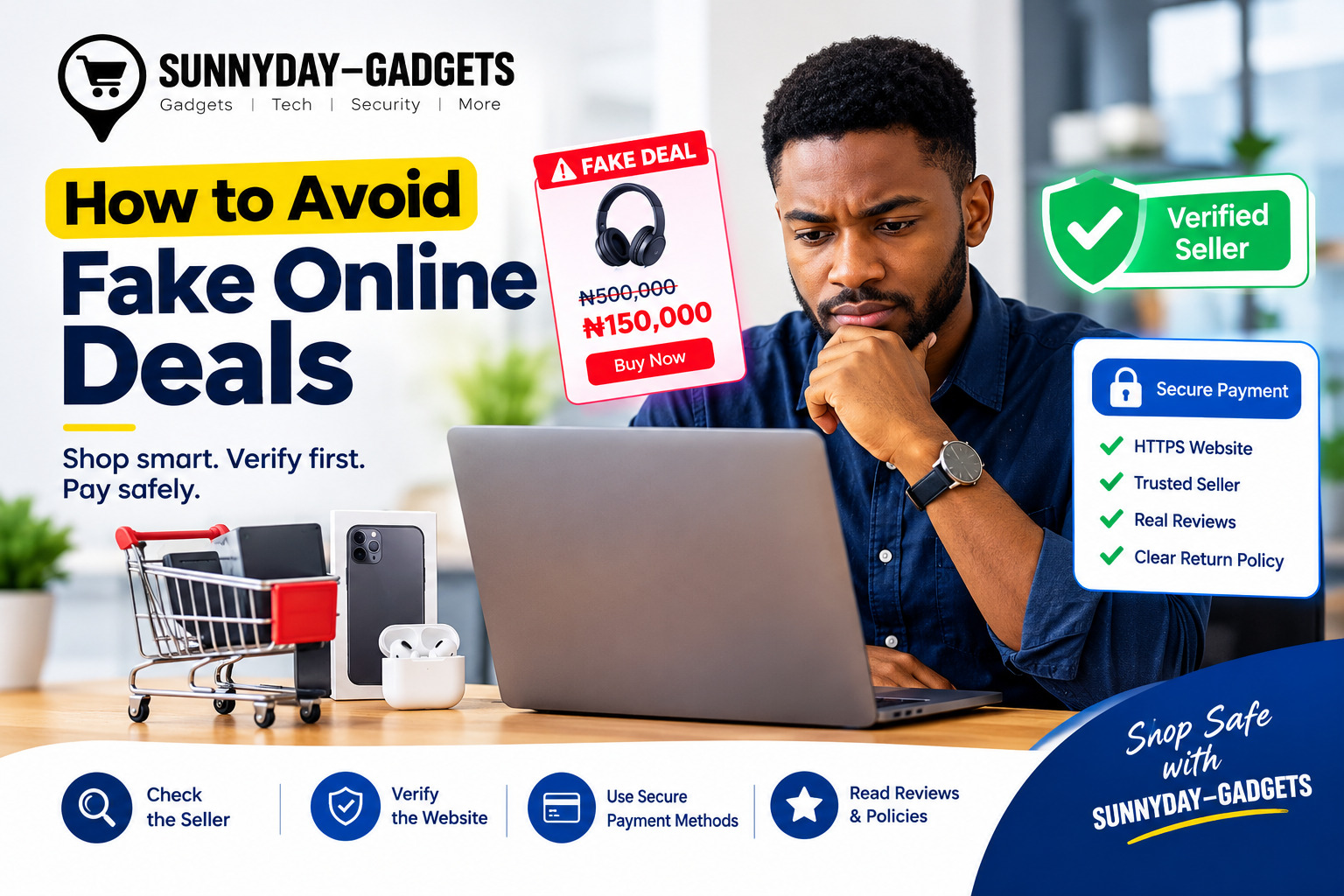
For example, if a smartphone normally sells for ₦500,000 but an unknown seller advertises it for ₦150,000 without a reasonable explanation, you should be cautious.
An unusually low price does not automatically mean the offer is fake, but it should encourage you to investigate further.
Before paying, compare the price with reputable online stores and other established sellers.
2. Verify the Seller Before Making Payment
Always research the seller before purchasing a product online.
Check:
- The seller’s website
- Physical business address
- Phone numbers
- Social media accounts
- Customer reviews
- Business registration information where applicable
- How long the business has been operating
- Previous customer experiences
Be particularly careful when dealing with a newly created social media account with little history, few followers, copied product images, or suspicious reviews.
3. Check the Website Carefully
Fake websites can look surprisingly professional. Scammers may copy the branding, product images, and layouts of legitimate businesses.
Before entering your personal or payment information, check the website address carefully.
Look for:
- Correct spelling of the domain name
- HTTPS and a valid security certificate
- Professional contact information
- Clear return and refund policies
- Terms and conditions
- Privacy policy
- Consistent company information
Remember that HTTPS alone does not prove that a website is legitimate. Scam websites can also use HTTPS certificates.
4. Avoid Sending Money to Personal Accounts Without Verification
Be cautious if a supposed business insists that you transfer money to an unrelated personal bank account.
For example, a seller claiming to operate a registered company but asking customers to send payments to multiple unrelated personal accounts should raise concerns.
Before transferring money, confirm:
- Account name
- Bank details
- Business name
- Order details
- Seller identity
If anything does not match, pause the transaction and investigate.
5. Don’t Trust Fake Discounts and Urgency
Scammers often pressure potential buyers by claiming that an offer will expire within minutes.
You may see messages such as:
- Pay now or lose this price!”
- Only one item remaining!”
- Offer ends in 10 minutes!”
Urgency can prevent you from thinking carefully about the transaction. A legitimate promotion should not require you to ignore basic safety checks.
Take your time and verify the seller before making payment.
6. Search for Reviews Outside the Seller’s Website
Do not rely entirely on reviews displayed on the seller’s website or social media page.
Scammers can create fake testimonials to make their businesses appear trustworthy.
Search for the company or seller on independent platforms and look for genuine customer experiences. Pay attention to repeated complaints involving:
- Non-delivery
- Fake products
- Poor customer service
- Refund problems
- Unexpected charges
- Blocked phone numbers after payment
A lack of any independent online presence can also be a warning sign.
7. Be Careful With Social Media Deals
Facebook, Instagram, TikTok, WhatsApp, and other social platforms are useful places to discover products, but they are also frequently used by online scammers.
Before purchasing through social media, verify:
- The account’s history
- Contact details
- Customer comments
- Previous posts
- Business location
- Website
- Payment information
Do not assume that a large number of followers automatically means the seller is legitimate. Followers, likes, and reviews can sometimes be manipulated.
8. Never Share Your OTP or Banking PIN
A legitimate online seller should never need your bank PIN, ATM PIN, or one-time password (OTP) to process a normal purchase.
Never share:
- Bank PIN
- Card PIN
- OTP
- Internet banking password
- Mobile banking password
- Verification codes
If someone claiming to be a seller, bank representative, delivery company, or customer-service agent asks for these details, stop communicating with them and verify the request through an official channel.
9. Check Product Images
Scammers frequently copy product images from legitimate websites.
If you are suspicious of an offer, perform a reverse image search to determine whether the same image appears on other websites.
Be especially careful when:
- Every product uses professionally photographed images.
- The seller has no original product photos.
- Images contain another company’s watermark.
- Product descriptions appear copied.
- Multiple unrelated sellers use exactly the same images.
10. Understand the Return and Refund Policy
Before purchasing an expensive product, find out what happens if the item is damaged, defective, counterfeit, or different from what you ordered.
A legitimate online business should provide clear information about:
- Returns
- Refunds
- Exchanges
- Warranty
- Delivery
- Damaged products
Avoid sellers who refuse to explain their refund policy before receiving payment.
11. Keep Records of Your Transactions
Always keep evidence of your online purchases.
Save:
- Order confirmations
- Receipts
- Payment information
- Invoices
- Seller conversations
- Screenshots
- Tracking numbers
- Product descriptions
These records can become important if you need to dispute a transaction or report suspected fraud.
12. Use Secure Payment Methods
Whenever possible, use trusted payment methods that provide transaction records and appropriate buyer protections.
Avoid unusual payment arrangements that make it difficult to trace or dispute a transaction.
For expensive purchases, be particularly cautious about requests for full payment through informal channels before the seller provides sufficient evidence that the business and product are legitimate.
13. Don’t Click Suspicious Links
Scammers may send fake promotional links through SMS, email, WhatsApp, or social media.
For example, a message might claim:
“Congratulations! You have won a new iPhone. Click here to claim your prize.”
The link may lead to a phishing website designed to steal your login details, card information, or other personal data.
Instead of clicking the link, visit the company’s official website by typing the address into your browser or using a trusted bookmark.
14. Watch Out for Fake Delivery Messages
Another common scam involves fake delivery notifications.
You may receive a message claiming that your package is waiting for delivery and asking you to pay a small “delivery fee” through a link.
Do not automatically trust such messages.
If you are expecting a package, verify the delivery information through the seller’s official website or the courier’s legitimate customer-service channel.
15. Trust Your Instincts
If something feels wrong about an online deal, stop and investigate.
A legitimate seller should be comfortable with reasonable questions about:
- Product authenticity
- Warranty
- Business location
- Payment
- Delivery
- Returns
Do not allow excitement over a discount to override basic security precautions.
What to Do If You Have Been Scammed
If you believe you have fallen victim to an online shopping scam, act quickly.
Contact your bank or payment provider immediately and explain what happened. Preserve all transaction records, messages, receipts, account details, and other evidence.
You should also report the suspected scam to the appropriate authorities or platform where the scam occurred.
If you entered your banking credentials or other sensitive information on a suspicious website, change your passwords immediately and monitor your accounts for unusual activity.
Final Thoughts
Knowing how to avoid fake online deals can help protect your money, personal information, and devices from online scammers. Before buying anything online, research the seller, compare prices, verify the website, check independent reviews, use secure payment methods, and avoid sharing sensitive banking information.
A genuine discount is valuable, but your security should always come first.
When shopping for gadgets online, choose businesses that provide clear product information, transparent policies, reliable customer support, and secure purchasing options.
https://www.aarp.org/money/scams-fraud/online-shopping/
Shop smart. Verify first. Pay safely.
